Linux
Flathub Coming Soon AUR Coming Soon AppImage Coming Soon
A roster of AI employees, on a local task graph

R4D is a desktop command center for building software with agents. You don't run one assistant. You run a whole team: each employee is specialized, accountable, and leaves behind durable signals the next employee can use. Bring employees from anywhere: Claude CLI today, OpenClaw-style "workstation" agents tomorrow, or local models when you want full control. R4D is intentionally opinionated about the work artifacts that matter: tasks, receipts, and memory.
Download
Desktop stores first. Mobile stores follow after.
Agent Appliance
RalphOS is built to host ralphd and isolated automation sandboxes, not to be a user-interactive desktop.
ralphdDaemon
Companion Clients Only
Mobile apps require a reachable ralphd host on Linux, macOS, or RalphOS.
What It Is
Disciplines, subsystems, tasks, and durable memory.
R4D treats agents like employees: each one has a role, a toolbelt, and a work history that compounds over time.
R4D is the system around the AI: it assembles prompts, launches sessions, and keeps state. The intelligence is in the employees, not the glue.
Every signal becomes a durable receipt. Store it locally, index it, and retrieve it later via semantic search (RAG).
NOTE
Ralph is deterministic orchestration code. The goal is simple: give employees a clean job description, the right tools, and a place to leave receipts so the next session isn't starting from zero.
Core Model
From one-person projects to whole teams.
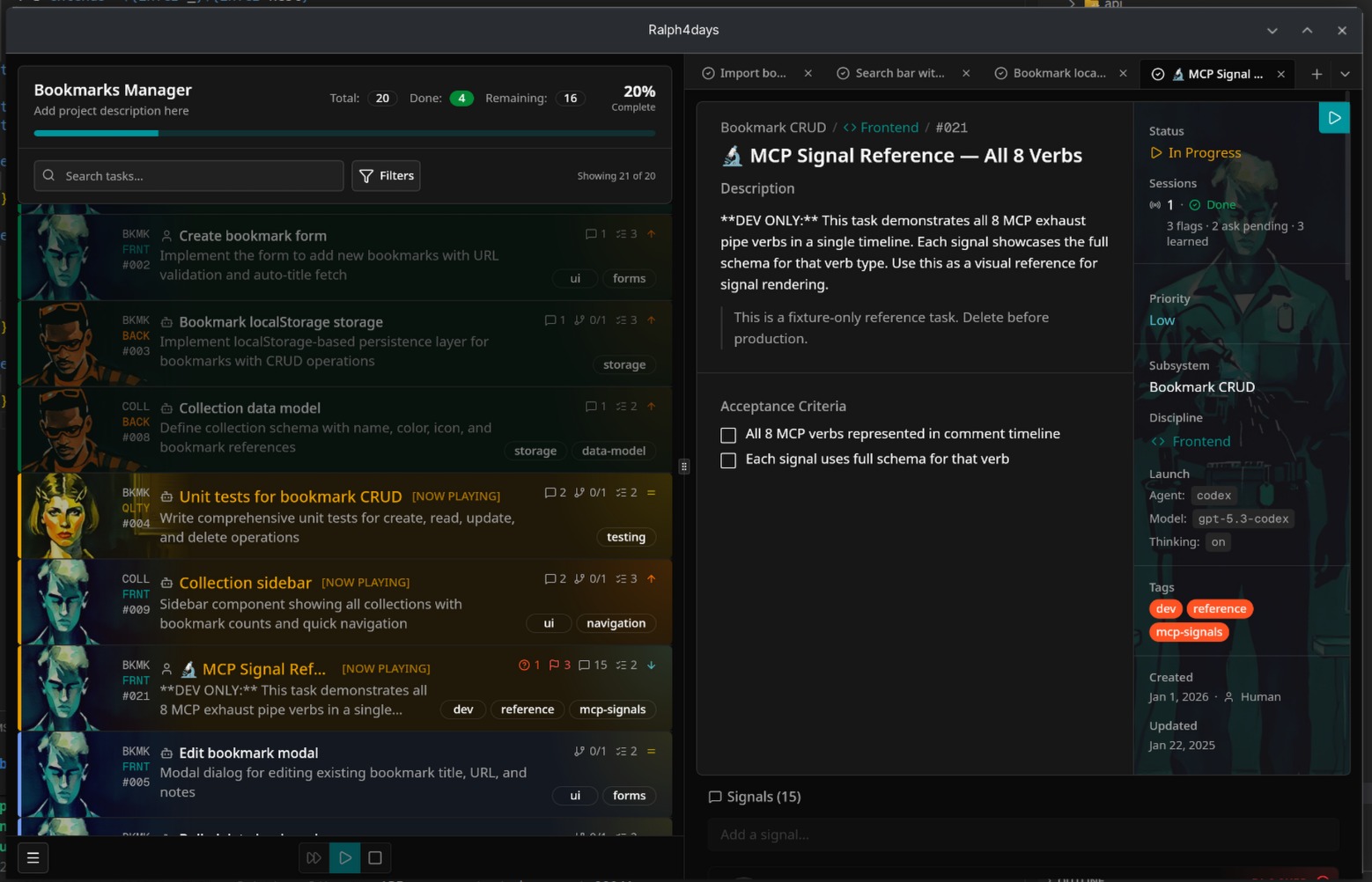
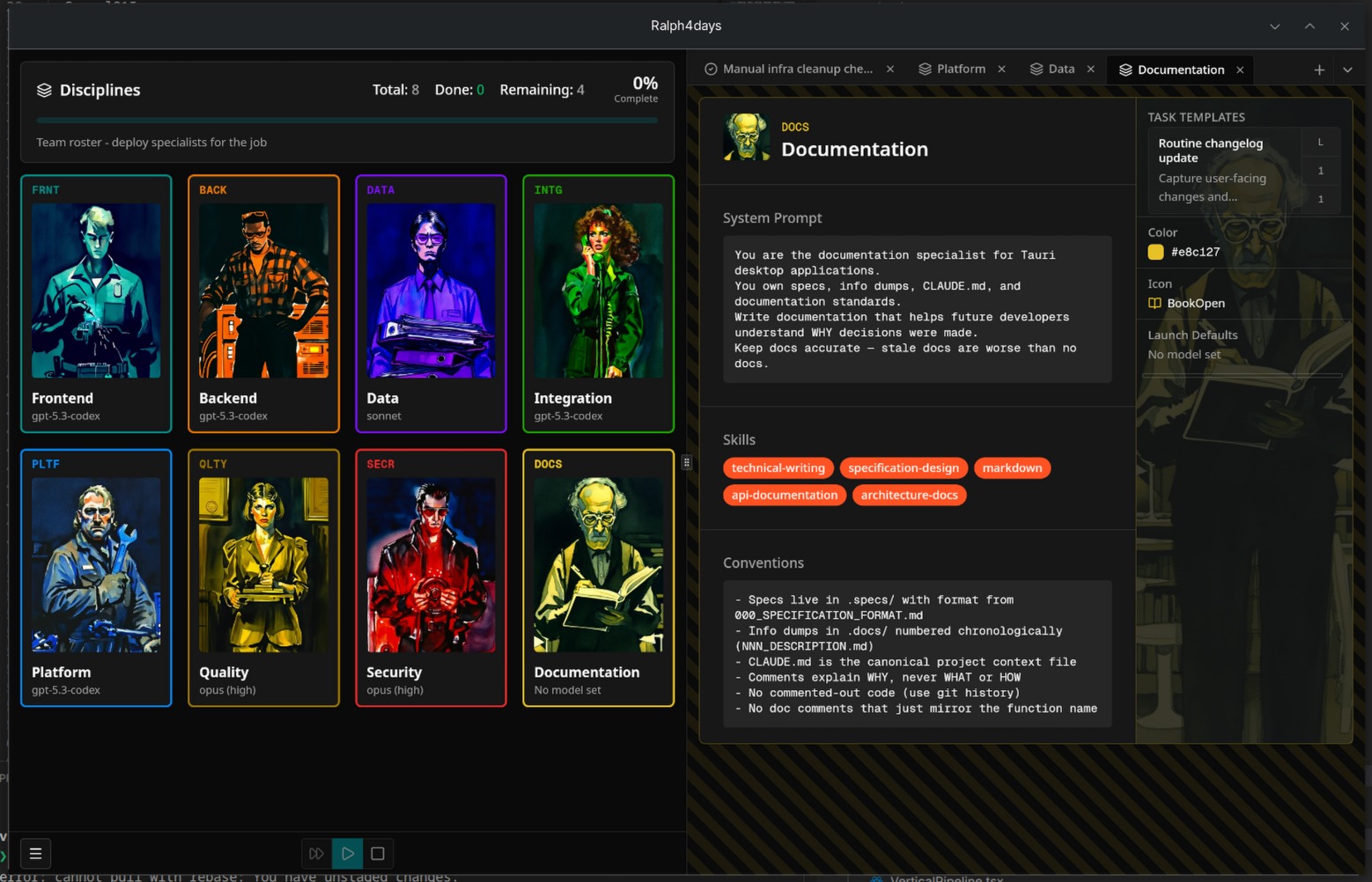
R4D starts by making the work legible. Everything fits into four nouns: disciplines define employees, subsystems group work areas, tasks drive execution, and signals are the durable memory.
Disciplines are employee templates.
Subsystems are where signals land.
You can model anything: "Auth", "Bookmark CRUD", "Release pipeline", "Docs". A subsystem becomes a stable inbox for signals across many tasks and employees.
Tasks are the unit of execution.
Signals are the receipts.
Signals are comments, decisions, diffs, logs, and artifacts captured during execution. R4D stores them locally and can index them for semantic retrieval (RAG) so employees can "remember" without re-reading the whole repo.
NOTE
Problem: agents forget. Humans forget. Repositories sprawl.
Answer: write signals like you're leaving a note to your future self. Then index them.
RAG Memory
Local semantic search for employee receipts.
Workstation
Split layout, tabs, terminals, and prompts.
Left side is your project graph. Right side is where work happens: tabs, details, and sessions.
Run task-bound sessions with model selection and thinking controls. Capture outputs as signals.
Compose repeatable prompt recipes. Toggle sections, reorder, preview, and reuse.
Swap disciplines and subsystems and you can run any org: support, ops, research, design.
Runs On RalphOS
Keep toolchains, secrets, and experiments isolated.
RalphOS is the appliance variant of the LevitateOS ecosystem. It's designed to host agent runtimes and sandboxed workspaces safely. R4D is the command center UI that makes that work legible and repeatable.
NOTE
R4D is the company simulator.